Motivational Interviewing (MI) is one of the core tools used in addiction treatment. Mental health professionals working with substance abusing clients should consider employing motivational interviewing, an empathic and client-centered approach that encourages patients to explore their ambivalence about change. Although the approach is effective, therapists and clinicians using MI are often faced with challenges in practice. At New Hope Womens Drug Rehabilitation Centre in Islamabad,a reputable drug addiction treatment center in Rawalpindi, we recognize the challenges you may face and provide practical strategies to overcome them.
Understanding Motivational Interviewing
Motivational interviewing is a health promotion technique that seeks to increase an individual’s intrinsic motivation to alter behavior. Certainly not through confrontational methods, rather MI is based on empathy, active listening and a non-combative mode of dialogue. It has been most successful with drug addiction, alcoholism and behavior problems. They will feel encouraged to share their reasons for wanting change, leading to greater chances of long-term success.
Although an effective intervention, MI is not without its limitations. Therapists and clients can run into roadblocks that thwart success. Identifying these challenges early and dealing with them effectively is critical to keeping treatment effective at any drug rehab in Rawalpindi.
Challenge 1: Patient Ambivalence
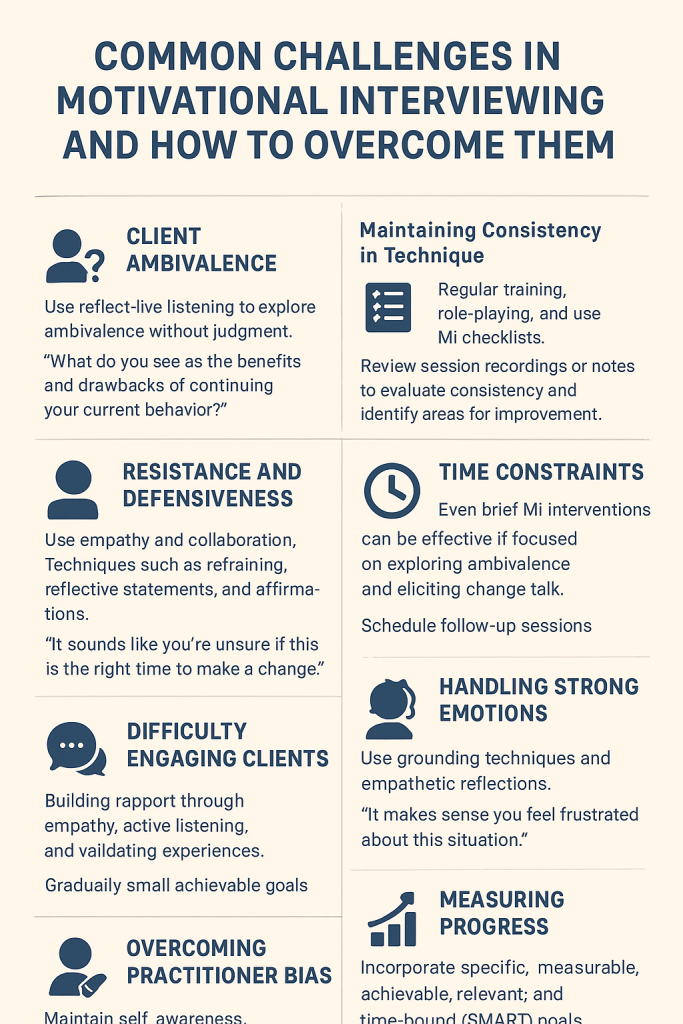
Ambivalence on the part of the patient is one of the most common dilemmas in motivational interviewing. Ambivalence is the conflicting thoughts or uncertainty patients have about whether they should change their behavior. For example, a penetration user may recognize the detrimental consequences of drug use but remain connected to the short-term self-medicating aspect.
How to Overcome:
Practice reflective listening: This involves describing back to the patient in slightly different words what they just said to validate their emotions.
Probe on both sides of ambivalence: Have patients talk through the pros and cons of their behavior.
Self-determination theory Emphasise autonomy: By making patients understand that the decision to change is completely their own does enhance engagement and self-motivation.
New Hope Women Rehab Centre Islamabad at our facility patients work through ambivalence with professionally trained counselors to gain clarity and make that commitment to healthy living.
Challenge 2: Resistance from Patients
Resistance is said to occur when patient actively or passively disapprove the discussion of change. This can lead to a show of disbelief or defensiveness (or checking out). Resistance is understandable, especially in someone who has undergone several failed attempts.
How to Overcome:
- Avoid confrontation: Arguing with a patient who resists can elicit more resistance.
- Roll with resistance: Get inquisitive rather than pushy, to get a sense of what worries the patient.
- Reframe responses: Change negative or reactive responses into opportunities for introspection.
Our drug rehab center in Rawalpindi uses non-threatening approaches that assure even rebel patients feel understood and appreciated.
Challenge 3: Limited Motivation
In some patients, motivation to change may be extremely low and it may not be possible for a MI conversation to occur. Motivation failure can be due to feeling hopelessness, previous unsuccessful attempts, or fear of relapse. Patients may look apathetic or disinterested if motivation is poor.
How to Overcome:
- Find manageable goals: Achieving success is motivating, and breaking larger aspirations into small steps can create a positive feedback loop.
- Emphasize personal values: By linking the motivation to change with the patient’s core beliefs, motivation can be increased.
- Have affirmations: Reflecting on past experiences and strengths provides confidence and engagement.
At New Hope Women Rehab Centre Islamabad, our therapists work to develop motivation steadily so the patients always feel that they are not alone.
Challenge 4: Communication Barriers
Good motivational interviewing depends heavily on open communication. Publications Barriers such as language barriers, cultural misunderstandings or emotional armors can certainly be obstacles. Sometimes clients find it difficult to articulate what they are thinking or feel misunderstood by the therapist.
How to Overcome:
- Utilize active listening: Demonstrate sincere interest and concentration in what the patient is saying.
- Ask open-ended questions: This will prompt patients to explain how they are feeling as opposed to answering “yes” or “no.”
- Modify style of communication: This will ensure that the flow of information is adjusted to, and not imposed on patients, enhancing comprehension, rapport and satisfaction.
Our Rawalpindi Drug rehab facilities believes in the practice of care with therapy, where our focus is on individual treatment as it’s best.
Challenge 5: Burnout and Fatigue of the Therapists
It can be emotionally draining for therapists to work in addiction recovery. Burnout or fatigue due to high case loads, difficult cases and repeated contact with patients in distress can impair the effectiveness of MI.
How to Overcome:
- Request for supervision and peer support: Having regular consultations with your peers gives you direction and emotional unloading.
- Take care of yourself: Therapists need to be in good mental and physical shape if they are to be effective.
- Ongoing learning: Participating in workshops or training on MI techniques is a way to refresh skills and boost confidence.
By making the physical and mental health of our staff a priority, New Hope Women Rehab Centre Islamabad, the top drug rehabilitation center in Rawalpindi fosters an environment where counselors can provide reliable, high-level treatment.
Challenge 6: Measuring Progress
The focus of motivational interviewing is on an individuals internal motivation and self-reflection, and tracking progress may sometimes be quite challenging. While it lacks concrete outcomes, like drug screens or attendance figures, the progress of MI is subtle and in the head.
How to Overcome:
- Qualitative changes: Document evidence of attitudinal change, willingness to participate or expressions of self-efficacy.
- Leverage patient reflections: Invite the patients to reflect on their progress and gains.
- Integrate MI with formal assessments: When we combine MI with structured tools, like assessment instruments, we will be able to actually track the progress.
We use a variety of evidence-based techniques, alongside motivational interviewing to deliver both oral and body oriented qualitative, quantitative measures of change in patients.
FAQs-the Challenges of Motivational Interviewing and How to Address Them
1. What is motivational interviewing used for in addiction treatment?
Motivational interviewing (MI) is a brief counseling method used in addiction treatment to explore patients’ ambivalence about change. It’s all about empathy, active listening, and collaboration–trying to help the patient discover her/his own reasons for leaving behind substance abuse.
2. What are the issues typically encountered in a motivational interview?
Challenges range from patient indifference, aversion to change and lack of motivation; barriers to communication, (e.g., cognitive problems; language issues); and the challenge of gauging progress. Practitioners can also suffer from fatigue or burnout when using MI with complex cases.
3. How can providers manage ambivalence in patients using MI?
Ambivalence can be resolved in therapy by means of reflective listening, pro’s and con’s-of behaviour exploration, and encouraging patient autonomy. This offers clarity and motivation to change.
4. What techniques help to overcome patient resistance within MI?
Some good techniques are avoiding confrontation, rolling with resistance and reframing negative statements. These strategies help patients feel heard and valued, increase engagement and willingness to participate in therapy.
5. Why is motivational interviewing necessary at a drug rehab in Rawalpindi?
MI is important because it helps patients become advocates for their own recovery. In an accredited drug rehabilitation facility in Rawalpindi, for example New Hope Women Rehab Centre Islamabad MI is used to help individuals overcome addiction together with proper medication and therapy programs.
Conclusion
While motivational interviewing is an effective tool for addiction recovery, it doesn’t come without its own struggles. This all makes the effective co-operation very challenging in MI sessions: patient’s ambivalence, reluctance, low motivation, communication problems of therapist burn-out and inability to measure progress. But there are ways to fight through this, with the right tools, training and mindset.
We support women on their journey to recovery from addiction At New Hope Women Rehab Centre Rawalpindi and the mantra at our exclusive drug rehab for women in Islamabad. Our expert counselor team uses customized motivational interviewing methods to ensure each person is treated with compassion and evidence-based care. By facing obstacles, we help strengthen the patient’s willingness to be openminded and accept change fully.
If you are looking for a Christ-centered rebound, New Hope Women Rehab Centre Islamabad offers women an encouraging and structured environment in which to break free from addiction. We are the go-to drug rehabilitation center for Rawalpindi and countless women benefit from our knowledge of motivational interviewing and holistic treatment methods.